About

As I walk the streets and roam the web of China, I share snapshots from my fieldwork on Bytes of China. My list of longer thought pieces can be found on my Writing Page

I am currently living in China, following students and migrants as they process information and desire, remaking cities and rural areas. I investigate media and memes in their collisions with markets, governments, and local thugs.   [More about Bytes of China.]

Here's a recent talk that I gave about my research, including this lovely article by An Xiao Mina. Read more about my research. My analysis of culture and technology can be found on Cultural Bytes. And my personal blog is Hi Tricia.

The views expressed on this blog do not in any way reflect the position of any of my funders, past employers, the Chinese government, the US government or the Fulbright program. 

Tweets
Funding

My research is generously funded though a mix of university grant programs, state initiatives, or industry research.

Read More

RSS Feeds
Recent Posts
Recent Updates
Monday
Feb062012

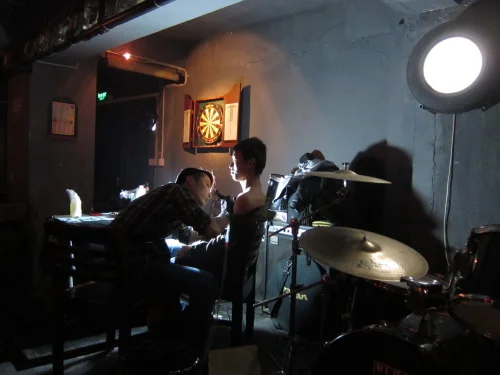
the bar as the ever evolving third space


I was hanging out the bar pictured above. After a rock band performed, the stage became a tattoo station. 

I love doing fieldwork in third places. Not only do I get to see all the different ways a space is used throughout a day, it's really easy to find people to talk to. 

Plus at a bar, a few drinks into the night, everyone is willing to talk. Good thing that I have high alcohol tolerance, not that that really matters considering that Chinese beers are the equivalent to water. I don't feel the alcohol but all the people I hang out with do. Makes my work a lot easier! It's more easy to watch who talks to who, who hits on who, and who goes to sleep with who. 

Monday
Feb062012

Cooks bonding over a cellphone

Lunch time is sleeping time for some and bonding time for others. The male cooks bond over games and/or pictures of “pretty girls” on their cellphonesThe waiters and waitresses nap before the doors open at 4pm. 

Lunch with one of my participants went longer than expected, which is always a good thing because that means they get to share a lot and I get to learn a lot. By the time we finished chatting, the entire staff had settled down on the second floor. I was so tired after the 3 hour lunch that I wanted to nap with the waiters and waitresses. But I gathered the energy to walk over to the chefs. They were quite squirmish about their cellphone; they immediately put the screen face down on the table, which usually means they were looking at "pretty girls."  

My participant was waiting downstairs, otherwise I would've tried to find out what kind of porn they were looking at and on what type of connection, whether it was downloaded by one of them or pre-installed by the vendor.

Sigh, there is only so much time in one day to do fielwork and there is only one of me. 


Monday
Feb062012

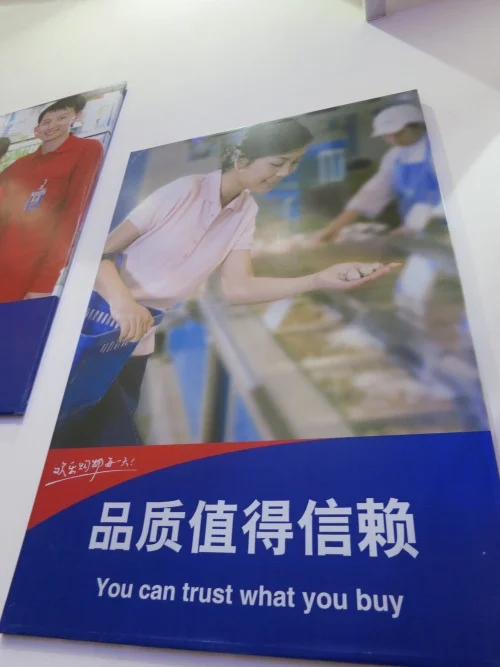
You can trust what you buy

I saw this sign at a TESCO grocery store in Dalian, Liaoning Province. Trust in products is a big topic offline and online.

"You can trust what you buy。"

“品质值得信赖"

Wednesday
Dec282011

Gossip from the trenches of China’s telecommunications market

(I originally wrote this post on 88 Bar.)

China telecommunications expert, Marc Laperrouza, tips us off to an unconfirmed bit a of juicy news about the Chinese telecommunication market: China Telecom is being investigated for anti-monopoly infringement! You don’t hear of state-owned enterprises the stature of China Telecom being investigated for monopoly infringement very often so this is pretty big news. Mark explains the charges:

Its sin(s)? Abuse of dominance in the broadband market or more specifically charging other broadband service operators discriminatory network access fees. For those not versed in competition law jargon it means that the company is taking advantage of its position in the market to squeeze out competitors (usually by forcing them to resell services to the final customer under the cost of production).

But like Mark, I am very curious why China Telecom? Is just doesn’t make sense.

The real question is why China Telecom’s counterpart (China Unicom) does not incur a similar investigation, given that both companies have nicely divided the country in two – the South for China Telecom and the North for China Unicom

While both China Telecom and China Unicom have divided the country in two, China Telecom was probably singled out first because they have the most subscribers – 73.7 million subscribers, compared with 779,000 users at China Unicom.

But it appears that in more recent news, China Telecom and China Unicom have been pressured by the anti-monoplogy probe to release statements admitting that they were improperly charging customers and would increase broadband speed. We have an explanation from, Li Qing, China’s National Development and Reform Commission’s  deputy director of the commission price supervision and anti-monopoly department:

These two companies clearly occupy a dominant position in the market…They use this dominant position to charge their rivals higher fees while offering favorable prices to companies that are not competing with them. According to antitrust law, we call such behavior price discrimination.”

And as with most monopolies, companies do not have incentives to offer optimal services. China has some of the slowest broadband speeds in the world despite having the most internet users out of any country. Anyone who has lived in China has become accustomed to slow internet speed.

But even governments needs incentives to break monopolies. The question is, why now? Is is possible that the government now sees the economic incentives to speed up service? Star Chang at Micgadget seems to think so:

An investment banker who cannot send an e-mail to his client or a supplier who cannot reach his buyers are a few examples of potential money loss that occurs on a daily basis. China Internet business will constantly need to deal with internet speed problems, a situation which is a loss for China and for the world. A huge population with fast internet connection speed will help drive innovation and will put China on the map as one of the most attractive business locations in the world. China must provide with faster and freer internet connection, making easier for people in China to engage in global business and to connect with the rest of the world.

But anything that involves faster access to any types of information comes with strings in China. I’m wondering how information will be filtered in an era of faster and more accessible internet? Earlier this year, Kaiser Kuo and others joked that we should all move to Chongqing  for the first International Cloud Computing Special Zone:

The special zone, covering about 10 square kilometers, is the only area in China that is directly connected to the outside Internet through optical fibers without being filtered, according to the Southern Weekend.

Kaiser’s joke points to something that would be good for all of us to keep an eye on – that is the future of cloud computing in China. Faster and more affordable internet can only get so fast if China’s internet infrastructure does not switch to cloud computing. But Jin Ge and I have been discussing the viability of home-grown cloud computing when Chinese netizens have low trust in cloud services from Chinese providers. When it’s already known that your information online is surveilled in China, who will be willing to save even more personal information online? According to Jin Ge’s latest article on China Bubble Watch, Cloud Computing Turned into Real Estate Business in China, no one is putting any information on the cloud servers. He points out that that the popularity of cloud servers are actually part of the real estate machine in China:

The first thing people should know about cloud computing in China is that it is again driven by state capitalism. Once the technocratic officials of China become aware of the concept of cloud computing, they immediately see the potential of applying their magic formula of “fixed asset investment+government subsidy+cheap loan” on it, because after all cloud computing does involve some large physical infrastructure. The story is quite similar to what happened to the concept of “Internet of Things”.

In April 2011, the government of Chongqing became the first to annouce its plan to invest 40 billion yuan on a cloud computing center that will be the largest in Asia. The plan is called “Yun Duan” (Top of Cloud). Then Shanghai, Beijing, Shenzhen and Guangzhou all followed suit. Shanghai plans to build a “Asia Pacific Cloud Computing Center”,  its plan is called “Yun Hai” (Ocean of Cloud), Beijing has a plan called “Xiang Yun” (Cloud of Blessing), Shenzhen has a plan called “Kun Yun” (Cloud of Flying Fish), Guangzhou has a plan called “Tian Yun” (Cloud of Sky), Ningbo has “Xing Yun” (Galaxy Cloud), Wuxi has “Yun Gu” (Cloud Valley), Hangzhou has “Yun Chao Shi” (Cloud Supermarket) ……

If Jin Ge is right, then we will see a cloud-computing bubble accompanying the yet-to-come real estate bubble.

From the clouds to the ground, 2012 looks like it’s going to be an exciting year for mobile  industry. China Telecom is going abroad to offer mobile services for the transnational elite who travel between China and North America. China Unicom just launched a new mobile internet platform, the Wo-plus Opening System. Let’s see how long China Mobile 600 million 2G users can wait for 3G before switching to Unicom or Telecom. Now that China is the world’s largest smartphone market, how will the future of hardware and software evolve? We already have a glimpse from HTC of their new Sina Weibo smartphone. And then to top if off, both China Telecom and China Unicom may lower broadband prices!

With all these technical and market changes, one of the big questions for 2012 is will Chinese citizens will be relieved of telecommunications costs? Or will 2012 could be the equivalent to the 1996 Telecommunications Act in the United States where institutions benefited more from telecommunication reforms than individuals? [1] We’ll have to see who benefits from thee anti-monopoly investigation.

With the stable divisions of China Unicom, China Mobile, & China Telecom, we don’t hear of potential industry shake ups like this very often. I imagine that Chinese Telcom scholar, Eric Harwitt, is giddy with news. But luckily we have  Marc Laperrouzag, so we won’t have to wait a few years for a book or paper to be published to stay up to date on the details.

Let’s hope for faster and more equitable broadband access in 2012! 新年快乐!

_______

[1] In my analysis of the US 1996 Telecommunication Act, I argued that the act did little to democratize communication for individual citizens. It failed to add Internet access to the scope of communication mediums covered by the Act; placed additional economic burdens on individual telephone subscribers; and auctioned off the spectrum of bandwidth for wireless services to the most wealthy telecommunications companies, who in turn charged high rates for wireless services to recoup costs. The act established the Universal Service Fund (USF) which mandated companies to create affordable telephone access, not information access, for individuals. While the USF was aimed at telephony services for  individuals,  E-rate, a sub-programof the USF, subsidized Internet access for schools and libraries, not individuals.

Monday
Dec192011

Street Vendor Life in China

UPDATE February 2012: I turned this blogpost into a longer piece for That's Shanghai, Dumplings for Sale. As with any publisher in mainland China, the censors have final say. In the end, most of what of wrote was approved, expect for the paragraph that I wrote on the chengguan. If you want to see what was cut, click here. Thanks for Leslie Jones, editor of That's Shanghai, for inviting me to write this piece! 

 (I conducted this fieldwork during the summer of 2011.)

I was living with migrants and working as a food vendor for the last few days. I want to give you an idea what everyday life is like for street vendors.

Background

The family I am living with received a tip from a friend about a construction site in the northern part of the city where vendors have been selling food during lunch and dinner without encountering any chengguan. When the family heard of a chengguan free-site, they were excited to check it out.

Officially know as City Urban Administrative and Law Enforcement Bureau (城市管理行政执法局), it's not really clear what they're supposed to do in practice. But what they're known for doing is making migrants' live miserable in cities across China. There are many stories online of chengguan beating vendors, smashing their products or food, and taking bribes. It's also common to hear about chengguan killing street vendors. A recent incident in Guizhou led to a riot when a chengguan killed a disabled migrant. Stories of chengguan exploitation of power are so pervasive that appeasing them with bribes becomes the key to a street vendor's success. Giving bribes is a matter of life or death.

But for migrants who do not have enough money to bribe, they have to constantly be on the run. Constant running means that a street vendor cannot establish a business long term. So for a street seller, like this family I am with, finding a place to set up a cart to sell food in a chengguan-free site is super important. A place to do stable business would give them a stable income to expand their business or go into another line of work.

After spending a a few days observing the site, they didn't see any chengguan officials amid the crowds of construction workers buying food and products from street vendors. They decided it was a safe and stable place to set up business. The family debated about what kind of food to sell. In the end they agreed to sell dumplings, noodles, and chaobing (炒饼) for 4RMB a serving. The family spent 6000RMB ($1000) of their savings to buy 2 battery-powered bicycles, 2 batteries, 1 freezer, 1 stove, 1 gas, 2 umbrellas, 2 large pots, 20 plastic orange bowls, 2 bags of disposable chopsticks, and 16 stools. Other than the chopsticks, everything was second hand. All 3 working adults agreed to participate in this work full-time. They moved to an an urban village slum near the work site.

Fieldnotes

We live in a city village slum (城种村) 20 minutes by bike from the construction site. Migrants from all around China live in this village, like any other urban village. 1 to 6 people rent out one room. Many parents live here with their child. Each room has a satellite dish attached to roof. The landlord lives at the end of the block and his floor is tiled. His job is to keep an eye on what happens in the area, but he appears to be gambling all day.

I sleep in a room with a four people: a mother and father with a 4 year old son, and the mother's little brother. The father and the little brother sleep on the bunk bed, I sleep with the mother and child on the floor. Rent is 300RMB/month ($50). Electricity costs around 450RMB/month at 1.5RMB/watt to keep the refrigerator on so that the food doesn't spoil. Electricity costs more than the rent. Charging the bike batteries also increases electricity costs. There is a television and a fan in the room.

This has been my schedule for the last 3 days:

4am     wake up and prepare bikes, put battery in
5am     head to market to buy fresh food for lunch
8am     return home, clean and wash vegetables
10am   cook food, load up bicycles, eat breakfast/lunch
11am   bike to the construction site and sell food
2pm     bike back to home, unload bicycles, clean pots & bowls, put stools & stuff back inside home
3pm     head to market to buy fresh food
5pm     return from market, wash vegetables, cook food
6pm     bike to construction site, sell food
8pm     bike back to home, unload car, clean bowls and pots
9pm     eat dinner
10pm   go to sleep

repeat.

But our schedule has not been this precise because we encounter many unpredictable problems.

The first few days have been disasterous in terms of making money.

Their bike keeps running out of battery so we have to push it 3 miles home each time this happens. The bike and the battery are second hand, so it's not clear if the problem is with the battery or the bike. The picture at the top of this post shows me pushing the cart after lunch in mid-day 99+ degree heat.

I found out that the refrigerator is only a freezer. But the family still puts everything that needs to be kept cold inside from beers to water to watermelon and to noodles. Sometimes the freezer works really well so there are a few beer explosions. But most of the time it doesn't work well so the dumplings become sticky and uncookable. We already have had to throw away 4 bags of dumplings.

The entire family is now exhausted after 3 days of working. Even the husband, who was really excited to do this new job because he's a really great cook, is now wanting to back out of this plan. In this picture below, he is preparing the lunch food outside the room. This is what their kitchen looks like. When he finishes chopping the meat, the flies come over to stake out their places as he prepares the noodles. No one swats the flies away or tries to keep the meat under some cover where flies can't reach. You would think it was a black stone if you didn't know it was hundreds of flies on top of the meat.

The soybeans are soaked (not washed) one time in a large aluminum bowl. This same bowl is used for washing hair, washing clothes, and bathing the 4 year old child. Food is cooked in a big pot on the ground using gas to power the cooker.

But the husband discovered that he didn't enjoy this type of mass-cooking and selling. Offering dumplings in 100+ degree weather has not been easy, not because there isn't a demand for dumplings, but because the dumplings are difficult to transport and they would become too mushy by the time we bike to the site. The bike ride from the urban village to the construction site is rocky. The road is not paved most of the way. By the time we arrive at the site, most of the soup has already spilled out of the large pot onto the cart. Keeping the soup hot with gas softens the dumplings.

The husband also found out that he has not been able to make food that pleases customers. Many workers complain after ordering the food. They often get angry and yell at them, demanding their money back. In this picture below, these workers want a beer to compensate for the overcooked dumplings. The husband, I could tell, is losing patience for this work. I hear him and his wife fighting about it. He wants to return to selling clothes on the street, even if it means dodging the chengguan everyday.


The family's electricity expenses are getting out of hand just to keep the freezer running. Electricity is more expensive at this particular urban village than their previous place they lived (1.5RMB/watt to 1.2RMB/watt respectively).

I can hear the husband and wife fighting about this every night. It puts a lot of stress on the family. The mother is getting nervous that they are not even close to turning a profit. Everyday around dinner time, she says, "we have to start making at least some money so that we can buy food.We need to buy meat." She needs cash to buy food for dinner. The most they have brought in so far was 200RMB on a good day. But most days only make 100RMB. The friend who told them about this place was supposedly making 500-600RMB a day. The younger brother keeps reminding the family of the friend's situation. Then the husband says that his friend makes a lot of money because sells good food. He pointed out that they didn't have return customers. All the other street vendors' carts had regular workers but no one ever came back to their cart.

Everyday activity has begun to wear on all of our bodies. Trips to the supermarkets, washing clothes, and going to the bathroom seemed to be a big ordeal.

Unloading and loading takes a total of 3 hours a day (4 rounds in total per day). Each bike ride to the market involves a total of 1 hour of loading and unloading items back into the room. Someone had to unload the cart, put everything inside the room, and then hide the valuable stuff (e.g. batteries) with a blanket. The reason why they have to go to the market in the morning and after lunch is because the freezer doesn't work properly. As a result, they could only buy food that can be cooked immediately. Not unloading is not an option because they need the free space in the cart to bring groceries back and they can't leave their belongings outside and not have it stolen.

Anything involving water takes ten times longer because there is only 1 faucet for every 4 homes. And there is only 1 pipe for every 5 faucets. So if any of the 20 families use a faucet, none of the other 19 families have access to a working faucet. Someone is always washing vegetables, dishes, hair, or clothes unless it is 3am in the morning. A few times we were not able to get arrive at the construction site in time to sell food because we were waiting to use the faucet. Water costs 10RMB/person/month. As a result, most of the food is not washed well or at all; it is soaked, and the same water is then used to soak other vegetables.

It is hard to even find a faucet just to get water to wipe the dust and sweat off of my body. And even when I do find faucet time, I am shy about wiping my body down in front of everyone. Since it is summer, families sit outside, eat outside, and gamble outside. There is no privacy. I can't wet the towel and walk inside the room because there is always someone there. No one else is shy about this. The mother wipes down her armpits, breasts, legs, stomach, and butt cheeks in the open.

There is no physical privacy in an urban village. None. At all. Even when you are going to the bathroom, not that it is an ideal place anyone wants to spend too much time in.

When I approach the bathroom, I can hear a faint buzzing sound. When my feet wade through the piles of trash blocking the bathroom entrance, I realize the buzzing sound  are flies. The swarm of flies that is so concentrated that it could lift me up into the air if I stay too long in the bathroom. The odor is nothing that I have ever experienced in my life. I have no words for it. All of these conditions make me avoid the bathroom as much as possible. In my past fieldwork with migrants, I am usually with street vendors who sell products in more urban areas where I could easily pop into a KFC or McDonalds to do a wipe-down shower. But this construction site is not located near any restaurants. So it is my only option.

I try to not use the bathroom as much as possible. But doing hard labor in 100+ degree weather makes the body thirsty. I am now very calculating everytime I drink water. I ask myself, do I really need this water?  Is it worth going to that bathroom? I now sip as little as possible, just enough to moisten my tongue so that it is not sticking to the top roof of my mouth. Yesterday was super hot, but I only used the bathroom twice in 24 hours. Imagining the conditions are enough to hold me back from quenching down a bottle of cold water.

The pit inside is filled to the top with feces, female pads, and trash. There is a rotting dog foot (body missing) in the female bathroom. No one has removed it. I want it removed, but I don't know how to remove it.  Even though I want to get rid the dog paw, I don't even know who to call. There is no such thing as animal control. I don't even know what tools I could use to remove it. I feel bad that other bathroom users have to see it and I feel horrible seeing it everytime I come here. Then I start wondering how this dog paw ended up here. There are many dogs in the village. Maybe a  car ran over a dog. But how did the paw end up in the bathroom? After some wondering, I realize it's time for me to return back home and help the family.  Little things like this, paralyze me because I realize how much I am unable to do here and how this is a reality for people living in these kind of areas. There is simply no time and no means to do anything to make this place cleaner.

With a schedule that requires us to wake up at 4am every morning, there is simply no time to do anything but prepare for the next meal or anticipate sleep. This is exhausting work and everyone collapses at the end of the night. Every night I bike home thinking, I cannot wait to sleep. Before I get home, I pray that the battery doesn't stop. I just want to make these 3 miles home on the electric bike.

I cannot even imagine how anyone working this kind of schedule has time to read a book, follow world news, or browse the internet.

Tuesday
Dec132011

The Future of Computing in China: Stories that Bind

The future of computing in China is a frequent topic in the tech community.

Most recently, NY Times published an article by John Markoff and David Barboza that discusses a near future where China's computing industry could close in on the US. The authors provided many examples, such as China's successful super computing industry and the number of programmers coming out of universities and being sent abroad.

James Landay wrote a response that countered Markoff's and Barboza's optimism. Landay explained that while China has made great strides reforming its academic system to produce top programmers, there are systematic issues (such as power structure within universities, the education system, and patent incentives) that prevent creativity among programmers from being rewarded. 

I'd like to extend upon Landay's comment on the cultural barriers to China's computing industry and offer my ideas of the primary challenges for the future of computing in China.

The three things holding China's computing industry from creating disruptive innovation is the 1.) lack of trust between individuals, groups, and institutions, 2.) lack of organizations that foster creativity and community, and 3.) lack of common myth among technologists, engineers, and programmers.

1. Trust matters

China's computing industry lacks trust between individuals and institutions. Both articles from Landay and Markoff and Barboza touch upon trust issues around patent protection. But when I talk about trust, I am referring to two types of trust, 1.) trust between individuals that leads (or doesn't) to collaborations, and 2.) social trust between individuals and institutions.

Markoff's and Barboza's article pointed to collaborations between universities as indicators of China's growing computer industry. But these collaborations are still far and few between and more importantly, they operate independently from each other. Industrial social structures matter in how industries form, as demonstrated by AnnaLee Saxenian's research on the emergence of Silicon Valley in California. Her analysis revealed that tech companies in Boston, Massachusetts Route 128 operated in a decentralized and independent fashion, while companies in California's Silicon Valley adopted a more decentralized but cooperative system. She argued that Silicon Valley was able to generate more innovation because its unique industrial structure encouraged collaboration between companies.

Trust is an essential factor for collaboration. The missing ingredient in Route 128 wasn't investment or human capital, it was trust. Without the underlying social bond of trust, companies were largely isolated from each other, which prevented collaboration. Lack of collaboration hindered healthy levels of sharing and competition.

The Chinese tech industry is set up more like Route 128 than Silicon Valley. There are pockets of innovation in China, but the innovators are not networked, nor are they collaborating. A common question that Chinese people ask is why China does not have a Steve Jobs. Whenever I hear this question, I ask myself, could Steve Jobs have created Apple in Route 128, instead of Silicon Valley? I'll leave that question for the experts to ponder.

Another type of trust that is missing is social trust of institutions. Aside from the major educational barriers that Landay pointed out and the legal intellectual property barriers that Markoff and Barboza highlighted, the general distrust in bureaucratic institutions is holding back the Chinese computing industry. In a country were information is explicitly filtered and monitored, how can people develop trust in large-scale computing systems? Sure, China has gotten this far by creating the fastest super-computers (at one point). But super-computing does not require high levels of trust, whereas cloud-computing does.

Cloud-computing is user-centric. One of the most important points in Landay's article is that cloud-computing is where innovations matter the most:

"people seem to see much more important innovation going on in the cloud computing clusters that literally combine thousands of commercial processors together in standard racks connected with traditional networks in huge data centers around the world. This is the technology that powers Google, Microsoft, Apple, Amazon, and the many other web computing giants of the world and is then resold inexpensively to every little web site or mobile phone application that needs to do computing in the cloud. This type of architecture supports a far wider range of applications than supercomputing."

If cloud-computing is a better indicator of where the Chinese computing industry is at, then it would appear from the recent burst of cloud-computing projects in China that its computing industry is doing quite well. Jin Ge reports on China Bubble Watch:

"In April 2011, the government of Chongqing became the first to announce its plan to invest 40 billion yuan on a cloud computing center that will be the largest in Asia. The plan is called “Yun Duan” (Top of Cloud). Then Shanghai, Beijing, Shenzhen and Guangzhou all followed suit. Shanghai plans to build a “Asia Pacific Cloud Computing Center”,  its plan is called “Yun Hai” (Ocean of Cloud), Beijing has a plan called “Xiang Yun” (Cloud of Blessing), Shenzhen has a plan called “Kun Yun” (Cloud of Flying Fish), Guangzhou has a plan called “Tian Yun” (Cloud of Sky), Ningbo has “Xing Yun” (Galaxy Cloud), Wuxi has “Yun Gu” (Cloud Valley), Hangzhou has “Yun Chao Shi” (Cloud Supermarket) ……

According to a report from China High Tech Herald, even poor cities like Lanzhou and Langfang joined the “cloud making carnival”. Langfang, a third tier city in Hebei province  announced its plan for a cloud storage center that is at least two times the size of the largest existing cloud storage center in the world, which is in Chicago."

But in China, anything that happens this quickly is suspect. Ge Jin reveals that cloud-computing is part of larger real-estate schemes.

"The first thing people should know about cloud computing in china is that it is again driven by state capitalism. Once the technocratic officials of China become aware of the concept of cloud computing, they immediately see the potential of applying their magic formula of “fixed asset investment+government subsidy+cheap loan” on it, because after all cloud computing does involve some large physical infrastructure."

Chinese efforts at cloud-computing are largely government subsidized projects built on shady relationships where it is not clear where money is coming from and where it is going. 

Jin Ge's article reveals the fundamental problem with cloud-computing in China - there is little trust in it. A common response from Chinese internet users is that they trust foreign internet companies more than Chinese internet companies with their information. Most users tell me that they don't trust putting their information up in the Chinese clouds because there is no guarantee that the company will be around next year. In addition, distrust of the government is also a common response. Having become accustomed to explicit information filtering from the largest cyber police force in the world, users have low trust in putting their information up in the clouds, thus another barrier to cloud-computing.


2. Organizational hubs of creativity matter.

China needs organizations that will foster creativity across software, hardware, and social boundaries.

Markoff and Barboza pointed to the rise of collaborations between institutions in China as indicators of China's burgeoning computer industry. I would be cautious of interpreting these indicators as measures of creativity, which is a critical element of disruptive innovation.

In Michele Hoyman's and Christopher Faricy's research, "It Takes a Village: A Test of the Creative Class, Social Capital and Human Capital Theories," they counter Richard Florida's work by arguing that creativity and economic growth can be mutually exclusive. Their work tells us that China can continue to experience great economic growth and computing progress without becoming a hub of creativity. So contrary to what Florida argues, creativity and economic development are not always positively correlated.

This is not to say that I don't see bubbles of amazing creativity in China. One only has to look to Silvia Lindtner's research on co-working and collaborative spaces like Xindanwei and Xinchejian for proof that China is not lacking in creative minds. But will these communities of creativity reach the tech industry at large? Will Chinese companies lead in creating shared value (Kevin Lee has a great post about this topic)? My experience so far tells me that in the Chinese computing industry, the answer is no, at least for now.

In research that I conducted (with Jofish Kaye) on hacker spaces in the Bay Area, I witnessed great fluidity between various creative spaces. People who worked at facebook could be found hacking away at Hacker Dojo or people who worked at a start-up would teach a class at Noisebridge. So far, I don't see any of that happening in China's co-working spaces. Even those these spaces are quite new, it's hard to imagine engineers at Tencent QQ taking time out of their grueling schedule to build an arduino board for fun. I see lots of Chinese artists and designers, and international techies at these new co-working spaces, but the missing group are the computer programmers from industry and academia.

I don't want to underestimate the importance of these new co-working communities, but a few of these sites scattered throughout the country is not enough for massive cultural change. What China needs is an organization that will cut through horizontal and vertical layers of bureaucracy, regional differences, software and hardware industries, and institutions, to bring together people to share.

The US has organizations whose sole mission is to build up the community between techies (the social science kind and programming kind) across industry and academia. Conferences organized by O'Reilly from Web 2.0 to Foo Camp bring together thousands of people in the computer industry to network, share, and play. Existing organizations are hardware and service specific. For example, organizations such as China Great Wall Club plays an important role in bringing together mobile internet service providers, but their audience does not expand beyond mobile, at least for now. And there are a few others organizations here and there, but they don't meet enough and often care more about membership fees than community development. China needs an organization, like O'Reilly, that will bring together academics, researchers, programmers, social scientists, hackers, artists, designers, and writers. Global research centers proposed by Landay would be a start.


3. Stories matter.

For China to become a disruptive innovator in computing, it needs a common myth to unifiy players from different social backgrounds. The lack of a common story prevents the emergence of a cohesive computing culture in China.

In Morgan Ames's research on One Lap Per Child, she looks at the kind of stories that technologists and programmers tell about themselves and how these stories are designed into technologies. She argues that the largely male culture of computer programming draws upon a mythologized childhood of independence from adults and freedom to explore computers. In their stories, programmers tend to ignore all the social and demographic factors that makes their story possible, such as being Caucasian, male, middle- to upper class, and having parents who encouraged them to use the computers, and going to schools that had access to computers. Regardless of how accurate these "pull yourself up by your own bootstrap" narratives are, it is a common one that binds computer programmers together.[2] Narratives can be powerful because they allow people to establish trust across time, social distance, and space. So what kinds of stories are circulating among Chinese programmers? I have yet to be able to identity a strong one yet.

Though I would like to point out an interesting story that comes from the mobile industry, the story of shanzai. What started out as a response from a few rogue mobile hardware producers in Southern China who wanted to avoid paying the government taxes on handset producers, has now spawned a whole industry of shanzai products that goes beyond the original definition of being cheap copies of existing products. Shanzai mobile makers did what Nokia, HTC, Samsung, and Motorola could not do - they met the user needs of millions of new cell[phone users (more on this topic from me). By working outside of the dominant infrastructure of mobile producers, shanzai makers went wild with producing mobile phones with new features that were relevant for low-end users. Shanzai mobiles has give the low-end market, that was once dominated by Nokia, a greater number of choices in mobiles at a lower cost. Shanzai is still in the process of moving beyond the perception of being a copy culture to a bottom-up innovation culture, so it is not a story that is embraced by the programming community at large right now.

All stories need a good enemy. For shanzai makers in China, it was the government that levied oppressive taxes. For hackers in the West, is was the education system that tried to prevent them from exploring self-directed learning. So who are the bad guys in the eyes of Chinese programmers?

                                                                               ***

Although I have named several barriers to China's computing industry, trust, creativity, and stories, I don't think that the Chinese computing industry will not be successful if it doesn't achieve all these factors, but whether it will be a Route 128 or Silicon Valley is still to be seen. Creativity and economic growth are not necessarily correlated.

Like Landay and many others, I'm not so optimistic about the actual system changing anytime soon. But here's the thing, I don't expect it to. Because systems take lots of time to change, and the bigger they are, the more change resistant they are. For example, compulsory public education in the US began in the early 1900s. In China, it only began in 1986. The US has had over 100 years to experiment with liberal education. China has only had a litte more than 20 years, and they have a lot more people.

My own research so far tells me that tech innovation in China will not model the West. For example, in the West, following the Bayh-Dole Act of 1980, universities and companies arrange mutually beneficial partnerships to facilitate the ease of IP transfer. This does not have to be a model elsewhere. Research from David Mowery and Bhaven Sampat (The Bayh-Dole Act of 1980 and University-Industry Technology Transfer: A Model for Other OECD Governments) cautions us from extending the US model of university-corporate partnerships globally because the success of the Bayh-Dole Act is heavily dependent on the history of education and tech industry in the US. And a recent paper from Paul M. Swamidass and Venubabu Vulasa, Why university inventions rarely produce income? Bottlenecks in university technology transfer, questions whether univeristy research is even producing marketable innovations. Both these studies bring up important points, innovation will look different in different contexts. [3]

The future of computing lies in individuals and groups who will collaborate across social and industry boundaries, and know  how to handle the unique constraints of technology usage in China as welcomed challenges. And this is why Lindtner's work on XindanWei and Xinchejian is so fascinating, because her research suggests that innovation in China may not come from the computer industry as we know it, it may come from these loose forms of transnational Chinese who breathe design, art, and tech. And my research on non-elite users and shanzai culture suggests that disruptions from the bottom up can contribute to the innovations in the field at large. Both of our research point to different dynamics of innovation than seen in the West.

In the meantime, we need more coverage of the Chinese tech scene from writers like Markoff and Barboza who avoid Western-centrism and more writing from experts like James Landay who can provide a nuanced insiders perspective. It's an exciting time to be a witness to how processes of trust building, creative development, and storytelling are being worked through in China as its economy is challenging the existing global order.

In Neil Stephenson's cyberpunk novel, Snow Crash, he writes that in an era of American economic decline where inflation is high and inequality is great,

"There's only four things we do better than anyone else: music, movies, microcode (software), and high-speed pizza delivery”

According to the prophet of the tech industry, despite economic decline in America, it will continue to provide good stories, software, and service.

-----------------

UPDATE Dec. 16, 2011: James Fallow refers to this article in What's Up in China: Hint, It's Not War With the U.S., The Atlantic

----------------------------------------------

[1] This is not to say that users' distrust will lead to more distrust in Chinese cloud-computing. Carol Heimer's research shows that strategies of distrust are not iterative, rather they can lead to the necessary groundwork for establishing trust.  For example, as suspect as US and Europeans are of companies' handling of individual's private data, it is this very suspicion that creates a healthy level of check and balances between companies and individuals.

[2] This mythologized childhood story of computer programming is shared by so many male techies that is often works in exclusionary ways, such as alienating females and minority programmers who do not share a similar childhood, as evidenced by research on gender biases in computing from Jane Margolis and Allen Fisher.

[3] Landay explained that the field of Ubiquitous Computing (Ubicomp) as lacking in Chinese scholars. But Ubicomp is not a field that the industry looks to for innovation. Students and researchers of Ubicomp and other similar fields are often times more concerned with producing papers than creating innovative contributions that will leave the lab.

Friday
Nov182011

Advertisement for No-fee ATM withdrawals anywhere in the world

There are signs everywhere that the expanding middle-class Chinese are globally mobile. Brands are noticing and catering to this new consumer. You can see it in the advertisements where companies are selling a specific lifestyle, such as this Toyota Highlander ad I saw a few months ago.

Even more interesting are ATM and credit card advertisements from Western companies. HSBC and American Express have long been marketing to global consumer. Their ads are more or less duplicated for each market with minor changes, such as translating a phrase or hiring ethnic models to represent the target market. But other than translation and localization, there is not much that differentiates an HSBC ad at London Heathrow from the one in Shanghai Pudong.

I saw this Citibank ATM ad as I was running through the doors of Hongqiao Train station in Shanghai to catch my flight back to Wuhan. In what looks to be a Chinese couple in a European city, the wife has happily returned from her shopping spree to a husband who was drinking an espresso. He appears to be quite happy seeing all her colorful shopping bags. With their no-fee withdrawal ATM card, both the husband and wife can enjoy their vacation without the worry of running out of cash.

Citibank reminds the viewer that these types of shopping experiences are possible because with an ATM card, shopping is now possible anywhere in the world.:

"you can withdraw money without paying fee [with Citibank ATM card], regardless if you are in this country or abroad, or withdrawing from Citibank or other banks."

This picture reflects the primary reason Chinese tourists travel: shopping. Chinese tourists overall prefer material experiences instead of relaxing or spiritual excursions. The The Economist tells us that they the Chinese tourist's ideal material experiences are not "in luxurious hotels and lavish meals. Coming from a newly affluent, increasingly unequal society, they have a strong preference for the accumulation of material goods.’” 

China Mike has compiled a list of statistics that show you just how much Chinese outbound travel has changed global tourism. For example, here are a few stats and graphs:

  • In 2008, Chinese tourists passed all other nationalities as the biggest shoppers in France, according to a survey by the French government. [The Financial Times, “Chinese travellers change the face of tourism” June 8, 2010]
  • The number of Chinese traveling outside the country rose to 54% from 2005 to 2009 (to 47.7 million)…and “they spent more than French, Japanese or Canadian travelers.” [U.N. World Tourism Organization; Time Mag. “Your Next Job: Made in India or China” March 17, 2011]

I've been seeing more ATM and credit cards from Western companies creating content specifically for Chinese middle- to upper-class tourists. If you spot any other ads like this one from Citibank ATM, please share!

Monday
Oct242011

His own style: A fashion choice that keeps people and crowds at a distance

Xin Kai (psyeudonym) is a wholesale clothing seller. I stopped by his story today and he told me about an incident that happened today with the chengguan

I write often about the chengguan. Officially, they are a bureau located in every city that is responsible for managing public spaces in a city. But they are more commonly known as a violent and deathly street mafia.

I also thought this conversation was interesting becaue we talked about the police stopping him because he looked different.

Xin Kai: Today the chengguan game.

Me: Why would they come for you? You have a store.

Xin Kai: I had all these new winter jackets dropped off from a seller and there wasn't room in my store, so the piles of jackets were placed in front of my store. Then the chengguan came and they didn't even ask if the jackets belonged to anyone. They just started putting my jackets in their truck. If I didn't come out earlier they would've just taken all my coats and all their family members would've been warm this winter. Bastards.

Me: How could they just do that?

Xin Kai: Ha, they don't have to ask, they can do that to anyone. They are the chengguan. But I got my stuff back with a little bit of arguing. 

Me: Well they probably didn't believe it was your stuff. You don't really look like a typical store owners.

Xin Kai: Yah I don't, great huh? [had a proud look on his face] They can't bully me that easily.

Me: Well you do look pretty different with your hair. [The top part of his hair is 2 inches long, the rest of it is buzzed, half of the hair on top is kept long that extends past his neck. He has a tatoo on one side of neck.]

Xin Kai: yah you like this? I used to have it even longer and then a few years ago I used to have the outline of my hand imprinted into the back of my head. Looked like someone had grabbed my head. It was pretty cool.

Me: What makes you think of all these creative styles?

Xin Kai: I like that it's different. I have a new style ever few years. Plus it keeps people far away from me. No one ever cuts in front of me. Like when I need to buy a ticket at the train station, people step out of my way. They think I am mafia member. Which is fine with me.

Me: Do the police ever stop you?

Xin Kai: All the time.

Me: Like where?

Xin Kai: At the train station, on the road. They used to stop me more, but now its more relaxed.

Me: Does it bother you that they stop you?

Xin Kai: What does it matter? I haven't done anything wrong. Sure you can run my identity. But I'm clean. I have nothing on me. This is me, this is my special look, fuck them if they don't like it. I'm not a bad person.

Me: So you know the power of your "look."

Xin Kai: Ya, I like it a lot. I am trying to think of what I should do next.

Me: maybe I should adopt your hairstyle - people are always cutting in front of line.

Monday
Oct242011

The New Luxury Consumer: White male serving Chinese couple in Toyota Highlander Advertisement

Oh how this Toyota Highlander advertisment is reflective of the new global order.  I saw this picture in Guangzhou's domestic terminal. A Chinese couple is getting out of their Japanese brand car into what appears to be a private yacht. A white male greets them, taking their travel items and appears to be eager  in their service. 

This advertisement reflects a new Chinese imaginary - one that is global, expansive, unlimited, and exploratory. It also tells us who has the power to live out this imaginary. 10 years ago or even 5 years ago, I don't think this advertisement would've existed. But now companies have turned to the Chinese consumer, encouraging them to participate in this lifestyle. The entire global economy right now depends on the Chinese elite and middle-class to spend. But how long can this go on for until we see the next crisis? For how long can each system create "value"?

As of right now:

“The ugliest part of the saga is that the well-being of many other countries is also in the impact zone when the donkey and the elephant fight,” Xinhua News

Sunday
Oct232011

Just Another Day of Fieldwork in China - Student singing for money on street

I felt off today. Everything was making me annoyed.

The grey air full of deathly toxins seemed to bother me more than usual. The bus exhaust in my face made my eyes sting. Walking on the street didn't seem faster than the sidewalk. Every pivot I made seemed to slow me down. I was totally off rhythm - motor bikes were blocking every possible space and bicyclists seemed to cut me off at every exploit to move ahead. It wasn't even hot but I was sweating just from the effort required to push through the crowds. A plume of kebab smoke enveloped my body, i knew I would smell like a stale fried piece of meat instead of my soap fresh body wash.

Congested bodies bumping into each other with no care for who is pushed or ran over. I walk past the bus station depot and I feel so tiny. Rows of buses waiting -  I could easily be squished in between two of them  and no one would help me, just like no one helped the 2 year old girl in Foshan who was ran over twice. The officials here would probably cover up the accident. What horrible thoughts I am imagining.

I am such a ball of negativity. I shouldn't be out in public right now because on any other day none of this would bother me.

Then then a voice pushed through the crowded space of sounds. A singing voice. But not the typical high pitched and stuffy karaoke voice. This voice was deep and honest. It was a young voice that carried itself through smoggy air and into your ears.

I walked up and saw that a crowd had gathered around the voice.

He was a young male. Like everyone else from my own world, I was drawn into a pause.  Crouching on the street with one arm awkwardly resting on his leg - the hand seemed to dangle. His microphone hand rested on top of his other arm. His body was compacted to take up minimal amount of space.

There were no obvious visual clues for why he would resort to singing on the street for money. His jeans appeared clean, his hair was long but not oily, his sneakers weren't falling apart, his color on his shirt remained true to its original black color, and his arms and face were not spotted with dirt.

He never looked up at the crowd. Not once did he turn around to see that there was a crowd of around 50 people on the steps in front of the mall standing and listening.

He wasn't a performer; he didn't have the air of a young street musician whose love is to sing for a living. To sing and ask for money, this was not his doing. Circumstances must have forced him to take his voice to the street. His voice was strong yet so unprepared and so unaware of how it could stop even a crowd - it grabbed me so much that I didn't even realize he was singing to music until he used a remote control to change the track for the next song.

I stepped through the crowd to read his hand written sign that was held down a money box.

I am a poor student from a mountainess rural area, I lost my father when I was young. My mother brought me and my sister up, she sent us to school. My sister got into Wuhan University of Technology, but because of economic problems my sister couldnt' go to school and had to work with my mom in the city. Then my sister got really sick and went into the hospital. The doctors tried their best to rescue her. But her sickness has made our family even more poor. So now I have to take one year off to make some money. Thank you to all who can donate money. I will always remember you.

This is the beauty of living in a city with streets that are alive. The streets hold stories. And even when you're feeling grumpy, you'll be given a distraction long enough to remind you of all the souls who share the world with you.

***

Fieldwork can be tiring and difficult on the body. I've been trying to slow down so that I don't become the grumpy anthropologist who no longer appreciates her own field site. But no one ever talks about this - how to be emotionally and physically healthy in long term fieldwork. We hear stories of anthropologists going off into their field sites, immersed into everyday life, and then they return to society with goodies of insights.
But what if everyday life is wearing on you? What if everyday life is wearing on the people you spend time with? What if it all feels so heavy that you forget why you are doing this fieldwork in the first place?
How do I keep my observations alive when what once seemed to be an observable distance is now hovering over me - like the sulfuric smelling smog that just makes me feel nauseous the moment I step outside?

I worry that I will begin missing stories like this young student.  If the conditions in my own fieldsite begin to annoy me, then that will be a bias what I observe and that could prevent me from seeing many moments that would've otherwise stood out to me before.

I just co-started a new blog with Heather Ford, Jenna Burrell, and Rachelle Annechino.  It's called Ethnography Matters. Well be talking about some of these issue on our blog. This inspires me to create a category with tips on how to remain balanced while doing fieldwork.

In the meantime, I will reflect on what my wonderful advisor Barry Brown suggested: for every 3 days of fieldwork, I should spend 2-3 days writing and another day resting.

Well it's been 6 months into fieldwork and I have yet to follow his advice.  I think this is a good time to start.

It's time to remind myself what a magical place I am in.

Thursday
Oct202011

Shanzai Nokia N9 has 7 OS interfaces, but most importantly it has Talking Tom & Stripping Games

In the wonderful world of shanzai, we have a new competitor made with a Mediatek chip- a Nokia N9 knockoff, the Noka (诺卡) N9. The Noka N9 has 7 operating systems interfaces: Meego, iOS 5.0, HTC Sense, Windows Phone 7, BlackBerry, Smasung’s TouchWiz  and Symbian Anna. This screenshot below from the video shows the user switching OS interfaces.

But it wasn't the impressive overload of OS interfaces, dual-sim card, 3.8″ WQVGA 240×400 resistive touch screen or the  1.3MP rear and front facing camera that caught my attention.

It was an advertisement on Taobao that revealed much more about what Chinese users want: games and porn (two areas I research). Below the description of the knock off, the first and most prominently placed feature of the Noka N9 was Talking Tom - a game that could that operate across platform. The writing in red claims that:

In all of history, this is the most versatile Talking Tom ever!!
史上功能最全的会说话的TOM猫!!

Then below three rows of Talking Tom screenshots, is another ad for a game that allows you to watch females strip when you blow on the microphone:

Most deliciosly evil game of pretty girls stripping!!

邪恶的美女走光游戏!!!

Then below the stripping games are more pictures of other games included in the phone from Angry Birds to Fruit Ninja.

If users just want games and stripping apps, then do they really need any of the other features that are offered in any of the original OS's  on phones that cost 3-15 times as much as knock offs? Not really, at least according to this Taobao advertisement which shows that it is possible to reduce user needs down to a few most necessary apps. The success of Shanzai mobiles tells us that the purity of an OS actually matters little to these users. They just want a phone that looks like a smartphone with games and basic features. The interesting point here is "looks like."  The Noka N9 is a semi-smartphone (半职能手机) that looks like a smartphone but doesn't have the full features of a pure smartphone. In previous interviews that I have conducted with shanzai phone users, they expressed that they valued durability (i.e. droppability. not longevitiy) and affordability in a phone. But in more recent interviews, they now the new value for non-elite users is to have a phone that can do the things that they see smartphone users doing - like interacting with more complex, interactive, & graphically rich stuff - like Talking Tom & Puff - a stripping game for you to look at girl's underwears.

This Noka N9 knock-off is apparently doing so well that even if you type in NOKIA N9 (诺基亚 N9) on Taobao's Hot Items, a list of NOKA N9 knock offs come up as the top results, covering the entire first page, which tells me that a sizable group of consumers are buying the shanzai version instead of the original N9.

*This post was prepared with the help of research assistant and manager, Pheona Chen.

Related Posts: The shanzai smartphone bandits are coming in China: My response to Nokia's CEO on 90% of the world not using smartphones - 6.27.2011


Monday
Jun272011

The shanzhai smarpthone bandits are coming in China! My response to Nokia's CEO on 90% of the world not using smartphones

This is a quote from Stephen Elop's first speech in Asia last week since becoming the CEO of Nokia.

The reality is that 90 percent of the world does not have or cannot afford a smartphone or a high-end device...This gap creates an opportunity.” Nokia's CEO

I wrote a blog post about shanzai phones last month that essentially serves as a very appropriate response to Elop's statement. Here's an excerpt below:

Cellphone producers worked with a Taiwan company that stands outside of Chinese governance, MediaTek, to quickly produce affordable and customizable cellphones that could flood markets within and outside of China. Essentially, cellphone producers dreamed of a way to operate outside of market regulations for cellphones and in the end shanzai phones now are estimated to makeup 20% of all cellphone sales within China. Millions of migrants can now have their dreams come true of connecting in real-time with friends and family, playing lots of games, going online, reading books, and taking photos - these non-elite users can finally afford cellphones just like anyone else in China. Shanzai culture is about equalizing the playing field for the most economically disadvantaged consumers. Now that is what I call a disruptive innvoation.

Now companies like Nokia and Microsoft are panicking because they are unable to compete in the crowded smartphone market. Longtime buyers of Nokia feature phones (symbian) have defected to Shanzai smart phones in masses. But Nokia still has an odd split in their company - they’ve set their company up in China (and India, Africa) to be split into two parts: emerging markets and smartphones. And now Nokia smartphones are switching to Microsoft platform (good-bye Meego!). But this means that Nokia has segmented their market into two groups and made two assumptions - that emerging markets still want to buy feature phones and elite-users want to buy expensive smart phones. Sorry, but this isn’t going to work because both non-elite users AND elite users want access to really cool smart-phones.

People in emerging markets are going to want to have access to the same features that expensive smartphones offer. They see the iPhone ads and they want the lifestyle that comes with it. So even if they can’t buy it from Nokia/Microsoft, iphone, or some Android phone  - they’re going to get it a smartphone with the SAME features from a shanzai smartphone. Sure shanzai smartphones are cheaply made and it may fall apart in 1 year, but guess what - that’s more of an excuse to buy a new one.  At such an affordable place, migrants can afford to get a new phone every year or so. My suggestion for any hardware manufacturer in emerging markets - learn more about your consumers.

In addition to what I already wrote last month, I have several thoughts about Elop's comment:

  • There are already companies that are ready to offer the 90% a very affordable smartphone.
  • It is misleading to think that this 90% won't spend more on cellphones than they did on feature phones.
  • Ahtough this 90% can't afford a smartphone now, it doesn't mean that they don't want one in the near future.

It would've been more accurate for Elop to say, "previously, 90 percent of the world could not afford a smartphone or a high-end device, but we are going to see affordable smarpthones enter the market and users who will spend more on mobiles...This creates an opportunity."

But I suspect that the reason why Nokia's CEO made his statement is because the market has yet to see the flooding of affordable smartphones. This is because Mediatek, the platform on shanzai phones, up until recently has only been able to offer 2G chips, not 3G chips.  But Mediatek is beginning to produce Android smartphones with their 3G MTK6516 cellphone chips, the first affordable shanzai smartphone. And now that Mediatek has sorted out legal issues with Qualcomm in a a cross-patent liscensing deal, they are moving upmarket and ensuring that their 2G customers transition to their 3G handsets.

So this means guerilla warfare on the smartphone market: Chinese cellphone makers will soon be producing smartphones that are much less expensive than the current array of smartphones ( i.e. iphones, HTCs, samsungs, and ericssons).

Can Nokia and Microsoft together figure out how to fight guerillas and out-wit bandit strategy?

In teaming up with Microsoft, a company who is also trying to figure out how to enter the smartphone, Nokia needs to make a decision: do they want to make mobiles for elite users or non-elite users? Does they want to compete with a handful of elite smartphone producers or do they want to compete with one really amazing company who just so happens to supply the 3G chips for a guerilla army of hundreds of smartphone manufacturers? 

In Nokia's transition from a hardware to software company, they have forgotten their mission: connecting people in affordable ways. If Nokia wants to return to their original mission and audience,  they should focus on producing cellphones for non-elite users - the 90% that Elop refers to in his speech.


Ethnographic converstaions with some of the 90%

In my research with non-elite users around the world, Nokia has always been at the heart of every conversation about cellphones. But I've noticed the decreasing ownership and desire of Nokia phones in the last 3-4 years, and it is even more apparent over the last year. The 3G market among non-elite users is already being created by current advertisement for high-end smartphones from iphone to HTC to Motorola. Cellphone vendors are selling 3G phones even in second hand cellphone markets. So even if non-elite users can't afford these phones, their desires for one are being nutured. High-end smartphones are paving the way for shanzai smartphones.

I just spent several days with construction workers this past week. I hung out with them after work hours working as a migrant worker at a food vendor carts and wandering around nearby second hand markets. These markets offer items from clothing to shoes and to cellphones.

Each of the cellphone sellers offered a range of shanzai feature phones, feature phones (Nokia, Lenova, and etc), and smartphones (open-android OS like Lenova, anycall). Construction workers make anywhere from 1500RMB to 4000RMB per month depending on their skill set. A used shanzai feature phone is usually around 50-100RMB. A used smartphone sells for around 800-1500RMB. This is a big difference, but if a younger worker don't have to support a family yet, he can afford to use a whole month's salary just on a phone.

  • I noticed a lot of workers picking up 2G phones that looked like smartphones - such as the fake iphone.
  • Even though I didn't see anyone purchase a 3G phone, I heard a lot of people asking questions about it and I saw people picking them up and turning it around in their hands, pushing buttons, playing games, and turning the music on. Essentially, they were interested but not ready to purchase.
  • I spoke to the sellers and they told me that while they didn't sell that many 3G smartphones, but people showed a lot of interest in them. I asked one seller would even make the effort to put it on the table for customers to buy. He explained that having a few 3G phones on the table gives customers a broader range of choices to chose from. It makes customers think that he was a good seller who had access to "good and high-end phones," even if these phones were not within the budgets of his consumers.

Nurturing Desire

What's striking in the moment of observation is that cellphone vendors and users in the non-elite market are all quite aware that the "smartphones" were not ready for consumption at that moment, but they were anticipating the moment for a future date. It's like what department stores do with window displays - they put the most expensive product for display knowing that most customers can't afford it but want something like it.

The younger construction workers I spoke to were "investigating" smartphones for themselves. Even if they coudn't afford it at that moment, they wanted the opportunity to play with the phone since the seller allowed people to interact with the phones. Many of them were saving up for a second hand smartphone that would cost anywhere from 300RMB to 1000RMB. The older construction workers just wanted a cheap feature phone, but sometimes I heard them asking about smartphones after they witnessed their younger counterparts inquiring about it and playing with it.


Here are some  conversations that I overhead:

  • A seller asked an older construction worker what kind of phone he were looking for, he said "one that can go online...look at video...I am giving it to my son."
  • One younger worker picked up an imitation 2G Apple iphone. He didn't know how to use the touchscreen and move to the next page. The seller taught him how to swipe. Sometimes he swiped too slowly or too fast so the screen didn't move. He became frustrated with the phone and aksed to see another one.  
  • Older worker, "I want a phone that comes with a box. I need to send one home." (meaning it was a gift and he wanted this second hand cellphone to come in the "original" box)
  • Younger worker: "Is this 3G thing fast enough for me to watch movies and videos?"
  • Young worker holding fake 2G iphone, "How do I save music?"


Some other observations:

  • Question about battery life were the most consistent concerns that I had heard from all workers. All of them live in dormitory like housing and most of the time there aren't enough plugs for every person's phone at one time. Even with an extension cord, there aren't usually enough outlets. But most feature phones have longer battery life than smartphones. All the workers wanted a phone that they didn't have to charge everyday.
  • Most people tested out the audio levels for music when they picked up  a phone.
  • Testing the phones was a very social process -  workers had a friend or two with him. So there was usually a friend overlooking a worker's shoulder and they would discuss the features of the phones, like what questions to ask the seller or what functions to test out.

A large portion of this 90% are read to buy smartphones not just because affordable phones will soon be available, but because the have the desire to own one.

With costs for hardware and infrastructural barriers to 3G access decreasing there is going to be a major market shift very soon when shanzai smartphones become available. From advertisements to cellphones vendors, the techno-social lifestyle of owning a "good phone" is being created before our eyes. With Western & Japanese markets nearing handset saturaion, in next few years the mobile market is shifting to focus on this 90% - understanding their desires, needs, and daily life is absolutely necessarily for any mobile company who is going to develop services for them.

Here are some factors from the user's perspective for Nokia and any other company to be aware of before entering the 3G non-elite market:

  • data plans for 3G phones are still relatively high compared to non-data plans
  • 3G phones eat up a lot of battery - this makes it hard for low-income or mobile workers who cannot charge their phone as easily -
  • 3G services are not as widely available yet in non-urban areas
  • there is a learning curve as people transition from 2G to 3G phone

It's going to be a few interesting years to see what happens in the smartphone market. Can established companies compete with these affordable smartphones? In terms of Nokia, the company really has some of the most brilliant researchers in their labs. They just opened another one in Shenzhen, China, the heart of shanzai culture. But Nokia doesn't have a technology problem, it has an institutional culture problem. Nokia's management needs to figure out how to let their researchers, programmers, & designers disrupt the entire mobile industry and hack apart the shanzai guerillas, or else the company may not learn how to take advantage of this "opportunity" that Nokia CEO Elops referred to in his speech.


Thursday
Jun232011

How I was treated on the subway when I was doing fieldwork as a migrant worker 

One of the people I've spending a lot of time in my fieldwork is Yang Jie. I wrote about her a few years ago when I met her on the street selling traditional Miao clothing and trinkets in Beijing.

Today, we both got on the subway together to head to one of the places she usually goes to sell her clothing.

She was carrying a bag over 70 pounds on her back. She is 5'2. She has the frame of someone who has been through a lifetime of work, a resilient body that could withstand hunger. I was carrying two bags for her also. Yang Jie also was carrying an plastic container that looked like it had been found on the side of the road - it had dirt encrusted into its crevices.

When we got on the subway, the passengers were not very friendly in giving us space to put down our bags even though the train wasn't crowded. When Yang Jie put her hands on the pole, passengers moved away from us.

I was dressed to blend in with Yang Jie, so I looked like a migrant street seller also.  There were no seats when we first got on the train, but then at the next stop two seats opened up. Yang Jie spoke loudly and told me to come over. Several people turned their heads to look at us.

The minute someone speaks and the second you glance at how a person is dressed, you can more or less make a guess what kind of background they have. It doesn't take long to see that Yang Jie is a probably from a village, is poor,  and part of a minority group.

Like Yang Jie, I am also darker skinned, so I had no problem blending in with her.  If you looked closely enough, the only give away that I wasn't really a migrant worker would be my manicured and painted red toe nails (this is something I am not willing to give up even when I'm doing fieldwork!).

Alhtough, I forgot that there was one more give-away and I found out quickly after we sat down.

When we sat down on the empty seat, I accidentally lightly brushed my backpack against the man sitting to my left. I immediately apologized.  But he didn't respond, he just looked alarmed that I had touched him and gave me a glaring look that told me immediately that I shouldn't even be sitting near him. He wiped off the part of his arm that my bag had brushed as if I had dumped dirt on his suit.

His action alone made me super conscious of my physical condition -  the dirt on my toes, my oily face, and my blackened clothing from working with food vendors. I hadn't showered in two days and that's all I kept thinking after he looked at me.  I glanced around around and saw people staring at us. I immediately made a boundary in my head and called them "city people." As Yang Jie kept talking, I kept noticing the "city people" in their daily showered bodies, freshly washed clothing, and dirt-free toes.

I then received a text message so I pulled my phone out. I immediately noticed the man next to me look at me curiously - he saw that I not only had a smartphone, but probably what looked like a real iphone (it is a real iphone). I texted back to my friend in English, and this is when he became super aware that something was off - it's hard to explain the look on his face, but he just kept looking over my shoulder as if his eyeballs were going to pop out. He then looked at  Yang Jie up and down and then at me up and down.

The more he looked, the more I just glared at him and the more upset I became. I wanted to say out loud, "what are you looking at? Do you have a problem? Aren't we too dirty for your eyes?"  But I was with Yang Jie and I didn't want to make a scene. I'm sure she receives this kind of treatment every day and she has learned to ignore it. It angered me that I could feel his judgement seeping onto me, and I could feel that the minute he saw me texting in English his level of disdain at me decrease. Texting in English in combination with owning an iphone are signifiers of an education and he picked up on it immediately.

Reflecting upon this story, I think this experience served as a fascinating moment for me to watch how technology works as a signifier for class, lifestyle, or respect.  Iphones (at least real ones) are still really expensive phones and when migrants save up for a year for an expensive smartphone, they usually are not dressed like me because they tend to work in non-labor intensive conditions like factories, restaurants, or hair salons. I saw the man's face change when he saw me pull my iphone; so the big contrast between how I was dressed and the technology that I owned was something that didn't make sense to him within this context.

I also started thinking about how migrants laborers begin to form their own categories about city people versus village people or people who wear suits versus people who wear working clothes. And I had to remind myself in that moment as I became fixated on the man's categorization of me that not all "city" people were similar. In the underground tunnels where rent is 350RMB/month - white collar workers make 1000RMB/month - the same as Yang Jie - a laboring street seller. Their income is the same but their outer appearances are radically different. To begin with, the white collar worker has access to a shower while people like Yang Jie who live in urban villages do not have access to a shower.  Their work also requires them to wear different types of clothing. So these catagorizations are misleading, but they can often be formed in moments when we feel the weight of a situation and need to make sense of it.

We all form categories about the world. I'm reminded now of Leigh Star's and Geoffrey Bowker's work on the power of classification as an enforcer of institutionalized ideologies in their amazing book, Sorting Things out: Classification and It's Consequences. Their main argument is that "all category systems are moral and political entities" that create and enforce beliefs and practices in our everyday lives. The way we see the world is constructed based on our experiences.

We have a moral and ethical agenda in our querying of these systems. Each standard and each category valorizes some point of view and silences another. This is not inherently a bad thing—indeed it is inescapable. But it is an ethical choice, and as such it is dangerous—not bad, but dangerous. (Bowker and Star, 5-6)

We are used to viewing moral choices as individual, as dilemmas, and as rational choices. We have an impoverished vocabulary for collective moral passages, to use Addelson’s terminology. For any individual, group or situation, classifications and standards give advantage or they give suffering. Jobs are made and lost; some regions benefit at the expense of others. How these choices are made, and how we may think about that invisible matching process, is at the core of the ethical project of this work. (Bowker and Star, 6)

I tried to imagine how would I see the world if I experienced this every single time I got on the train. Would I become bitter, would I form over-arching categories about "city" people so that I could make sense of how I was treated, would I essentialize anyone who looked like they were well dressed or showered?

When I try to think about these questions I am even more amazed at Yang Jie's life. When we first met, I looked like what I had just categorized as a "city" person. I was working as a visiting scholar at the China Internet Network Information Center and was wearing office attire every day. I showered everyday and always had clean clothes on with high heels. And still, Yang Jie treated me with respect. She didn't put me into the category of "city person" or "rich person" or "white collar worker."

What I remember the most about meeting Yang Jie is that I didn't have to prove myself to her that I wasn't  judgmental or didn't look down on her. Often times when I meet migrants  and they know that I'm not a migrant, I work very hard to make sure that I convey to them that I don't look down upon them. It takes a lot of energy and trust to convince someone that you see them as equals. Sometimes the social divide is too great in their minds and I am not able to convince them otherwise. Sometimes I don't get enough time to spend with them to build the trust and to show them that I am not one of "those" people. I can always tell when people still don't believe that I see myself as their equals.  When this happens, I am not able to do in-depth ethnography because people don't open up to me when they don't feel comfortable. They often give stilted answers and just aren't willing to share their stories.

Back to the discussion of technology. Marketing creates our desires for the the newest and shiny products. In all possible advertising spaces in China from subway walls to the the exterior of buses and shopping malls, posters showing off the wonders of 3G smartphones are everywhere. We are seeing the creation of desires in the making - the desire of a smartphone.

My experience illustrates the type of power a piece of technology can convey in everyday life. Will first time smarphone owning migrants experience the same kind of treatment I received today? Will they notice people giving them better treatment once they pull out thier cellphone?

I remember in high school when I got my first pager, I tried to find every way possible to let students know that I owned one. I was bullied in high school for being one of the few Chinese faces in a all white, middle to upper class suburb. So I yearned for any kind of signal that would convey that I was also able to participate in a smiliar lifestyle. I even recall one time in AP History when I purposely left my pager on so that everyone could hear it ring. No one paged me that time.

I predict that soon we will see 3G shanzai smartphones flood the market, but the question is how much do the current non-elite users of 2G feature phones really need these smartphones? Of course this is a bit of a rhetorical question because in the end how much do any of us really need our technologies. None of can really objectively answer this! Do I really need Cat Paint on my iphone? NO! but YES! YES because it makes me really happy to draw cats flying over my friends' heads.  But the more interesting question is to find out how migrants construct their own technology needs. How do non-elite users describe their reasons for transitioning from a feature to a smartphone?  What does the transition from a feature to a smartphone mean for them? Will it provide them with greater economic opportunities? Will it allow them to stay in touch with their families more easily? or will it create new problems? I'll find out in the next year as I watch the transition. I hope to catch people right as the shanzai smartphone enter the market and do some before and after ethnography.

I also thought of Anil Dash's Last Year's Model campaign. Maybe we need something similar here in China!

_______________

Stay posted for my piece next week where I respond to Nokia's CEO who made a comment that 90% of the world cannot afford a smartphone.

UPDATE JUNE 29, 2011:  My thoughts on Nokia, Smartphones, and the other 90%


Sunday
Jun192011

warm hot dogs: protein source in internet cafe


I was hanging out an internet cafe around 4pm in the afternoon on a weekday.

For each cafe that I spend time at, I do a quick and dirty subjective rating of each cafe on a scale of 1-10 stars, 10 being the most luxurious and 1 being the most dilipidated.

This cafe is on the nicer end; I would've given it a 7 but I gave it 8 because they offer warm hot dogs - note the keyword - warm. Most cafes, if they offer hot dogs, sell cold hot dogs snacks in a wrapper.

Here is a short excerpt from my fieldnotes about this cafe.

Cafe rating - 8 stars: air-conditioned, requires identification cards and they appear to check them, no mosquitos or flies, keyboard and mouse appear to be clean, available warm food (hot dog in food display, bathroom located on same floor as cafe (2nd floor), cloth on chairs are in place, no nuts or food scattered on ground, the workers seems responsive when customers need help, cubicles in back appear ot be new

keyboards are not stained with dirt though the keyboards are black so it would be hard to see the dirt  -but I don't see food encrusted in between the keys

estimate: total of 100-120 computers, 60 computers are being used with around 40 people playing games and 15 people watching videos and 5 people on websites browsing, 40 females and 20 males, I see 5-6 couples together, there are 2-3 people napping at all times

most customers playing games have a soft-drink or sugar beverage with them, some have lots of wrappers of candies and other snacks spread around their keyboard

within the last hour, two customers (one male & one female) bought 1 hot dog each, the meat is kept warm in a transparent plastic food display with a light, you can see the oil on the hot dog bubbling up, 1RMB each, customers went back to their computer and began playing their game, the female was playing a dancing/clothing game of some sort, male playing first person CS-like game

there's a sudden down pour outside, people are running in with drenched clothes and hair, the internet cafe is dry, are they coming here to use the computer or coming here to get away from the rain?

overheard conversation: let's just pay for 1 hour, check to see if companies have emailed me back, and then the rain will probably clear up

I wonder how many people have been living here, how many people are on a gaming deadline (like joined a team or bought in-game items that will expire), where are these people from, how many people are lookin for a job, who lives in the nearby tunnel, how many alrady have internet access at home

Thursday
Jun162011

Life Underground: an ethernet line to the outside world with no windows

I've been touring underground tunnels looking for a short-term rental. This is the room that I've decided to rent. The room includes an incredibly dilapidated twin bed and a wooden desk. To give you an idea of the size of this particular room, it's as big as a large walk-in American closet and smaller than a queen sized bed. These rooms cost 350RMB/month. Some rooms have a double-bed or a TV, and those cost a bit more.

Each room comes with an ethernet cable; internet costs 60RMB/month.

There is no way to tell if it is daytime or nighttime as there are no windows in the room. There are two ways to find out the time of day: look at the time on your cellphone/clock or walk all the way up into the upper-ground world.

Saturday
Jun112011

Empty Condom Dispensing Machines

Even though there are condom vending machines scattered through out the city, I have yet to find one that could dispense even one condom. It only takes coins.

All the machinese have a picture of a male and female hugging on a beach. Wuhan is very far from the ocean, it is in the middle of the country. Most people have not seen the ocean. 


Saturday
Jun112011

Using 驴友 BBS Message Boards to Find Travel Friends

I met a young, college student at a bus stop while I was waiting for a bus with a friend.

He is from Jiangxi Provence and is in Wuhan studying to be a train operator. His father was also a train operator.

He is going to catch a night train to Changsha in Hunan Provence.

After he shared with me where he was going, I asked him why he was going to Changsha all by himself at 11pm in the middle of the night. He explained that he needed a break from his girlfriend. She was being difficult and he couldn't rest, so he just decided to get up and leave, hoping that it would make him feel better.

He seemed visibly frustrated, constantly checking his phone.

Him and his girlfriend have been together for 1 year and its the first relationship for both of them. She is a college student and he is going to have a very safe job inside the state-run train company. They already broke up once, but then they got back together.

But recently, she's been ignoring his calls. A week before she suggested that they take a break, but he didn't agree to it. Just a few hours ago, he called her and she answered the phone but she said that she was out with friends at KTV and then hung up on him. He could hear several people laughing in the background.

I asked him for more details about their relationship. He said that he wants to marry her and that both of their parents approve of the relationship. He can give her a stable life. I then asked if he felt this was the right decision even though it was only their first relationship and she already seems to want to take a break. He responded, "Does it matter? The point is that I can take care of her and we can be together. We are a good match for each other. What's the point of a break? We rarely see each other."

He lost his virginity to her. He was 21 years old. The first girl he had ever kissed, the first girl he had ever slept with, and the only girl he wants to be with forever. Even though they live in the same city, they only see each other once or twice every month because they both go to different universities.

I then asked why he was constantly looking at his phone, he said that he was hoping she would call and tell him that she wanted to see him.

I then asked about where he got his current phone. He said it was his third phone this year. The first was a Nokia smartphone that was stolen out of his dormitory while he was sleeping last summer. Someone stole phones that were being charged while students were sleeping. He replaced it with another Nokia smartphone but then that was stolen on a bus. Then he bought this used Shanzai phone for 50RMB. He can't get online with this latest phone but he can do simple apps like QQ. He keeps all his contact info on his QQ address book.

He then explained that he uses a vacationing BBS (驴友bbs) site where strangers organize meet-ups in cities around China. After his girlfriend hung up on him, he turned to the vacationing BBS and found several people who were going to Changsha. He made contact with them, exchanged cellphone numbers, and agreed to meet up at a hostel in Changsha the next morning. After meeting up, they would go as a group to a travel agency to buy tickets for local touristic sites.

I asked if he only travels when he's upset, he said no. He used to travel more often when he was single. He prefers to travel alone to a new city because it's more convenient to coordinate with strangers than friends. He found traveling with friends to be too complicated because he had to consider their needs, negotiate where to go, and to make compromises. With strangers he found that he could do what he wanted without feeling guilty.  He could tell them that he was going to a museum and then meet up with them in the afternoon. With a friend, he couldn't do that; they would have to stick together the entire time.

I asked what he hoped would happen after he came back from his Changsha vacation. He plans to call her when he returns and hopes that his girlfriend realizes how much she missed him.

He doesn't really keep in touch with people he meets on these trips. He doesn't have any plans to travel with the same people again unless they bump into each other on the BBS again and just so happen to be going to the same city.

This student comes from at least a lower-middle class family. His family had enough connections to get him into the training program based off of his father's employment. He uses the internet as a place for finding random connections for temporary activities. He isn't using it to create lasting relationships. He believes that he is already in one, but it appears from his story that his girlfriend may not be on the same page with him.

Saturday
Jun112011

Explosion at Construction Site - No Public Reports

I was walking by this construction site above with my friend Lao Meng when we heard a humongous explosion and then saw large metal sharples the size of car tires flying onto the street. We both just stood there watching everyone panic and running away from the site. We didn't see any pieces of metal land on anyone; the metal flew over everyone's heads and onto the street. And we were safe in the end. It was shook us up a bit and reminded us that it's quite normal for several deaths to be associated with each construction project.

We couldn't get any answers about what happened. Construction sites are very private about what goes inside their walls. If they see you taking pictures, someone will come up to question you on why you're taking photos and harrass you.

We will probably never know if any migrant worker was injured  or killed. There were no reports of this in the newspapers the next day. From my apartment building I could see a big hole had been blasted out on the site and they had to tear down several levels of concrete. It appears that they had to start all over again after the blast.

Chinese construction companies are notorious for creating shoddy buildings. Some apartments begin to show problems with the first few years. But construction companies often change their names, so it becomes difficult to hold the company responsible for the building. Most of these buildings are only made to last 25-30 years, even though the government requires them to last 50 to 100 years. According to the Land Administration Law that was last modified in 1988, people only have residential rights to buildings for 70 years from date of purchase.

Below are some pictures of what the area surrounding a construction site loosk like - the walls block pedestrains from seeing the site and the sidewalks are filled with dust. The walls are usually plastered with advertisments symbolizing the success of construction projects.


Saturday
Jun112011

Technolgies of Luxury: Toilet Ads featuring "Western Toilets" are a sign of luxury

All around the city are advertisements for "Western" styled toilets that have lids, seat, and raised base. No squatting is required. In new apartment buildings, there are ads pasted in elevator entrances. Usually there is a woman in a dress pointing to the toilet. This is the first ad that I've seen with a male baby holding his penis as he urinates into the toilet.

The western toilet, along with iphones and ipads, are all part of this new wave of technologies of luxury in China.

Saturday
Jun112011

Man on bus having difficulty with his cellphone stylus


This older man is using his stylus to write Chinese characters for a text message. He keeps having to take his glasses on and off to write it. He writes a few strokes, then presses a button, then puts his glasses back on, and then repeats the entire process. The bus is also very bumpy so he is trying to stablize the mobile with his hands.

Across the aisle, a girl is cutting her nails (picture below).