Tweets
Funding

My research is generously funded though a mix of university grant programs, state initiatives, or industry research.

Read More

RSS Feeds
Recent Updates
Friday
Sep302011

Presented paper that I co-wrote with Barrry Brown at Mobile HCI 2011

I got to spend a wonderful few days in Stockholm, Sweden for Mobile HCI 2011. I presented a paper that Barry Brown and I co-wrote about our research in mobile use in Mexico, Ethnography of the telephone: Changing uses of communication technology in village life. Here is the pdf and the abstract of our paper:

While mobile HCI has encompassed a range of devices and systems, telephone calls on cellphones remain the most prevalent contemporary form of mobile technology use. In this paper we document ethnographic work studying a remote Mexican village’s use of cellphones alongside conventional phones, satellite phones and the Internet. While few homes in the village we studied have running water, many children have iPods and the Internet cafe in the closest town is heavily used to access YouTube, Wikipedia, and MSN messenger. Alongside cost, the Internet fits into the communication patterns and daily routines in a way that cellphones do not. We document the variety of communication strategies that balance cost, availability and complexity. Instead of finding that new technologies replace old, we find that different technologies co-exist, with fixed phones co-existing with instant message, cellphones and shared community phones. The paper concludes by discussing how we can study mobile technology and design for settings defined by cost and infrastructure availability.

This paper is a shorter version of a paper that we presented at the International Communication Association (ICA) [pdf] in Chicago. I learned a lot through re-writing this paper with Barry (who publishes papers in his sleep).

For me, the new version was difficult to write because we had to cut so many details out from our original ICA paper, but it gave us an opportunity to tell a different story about our data. While we had to leave out a lot of data, it allowed us to highlight our data in different ways. I personally don't like writing academic papers, but if there is anyone I would do it with again, it would be Barry.

This was my first time at Mobile HCI, so it was super fun to meet new faces and see old friends. But best of all, I got to spend time with Barry, who is now moving from UC San Diego to Mobile Life in Stockholm to start a new research group. Sadness for me, but wonderful news for his colleagues in Sweden.

Monday
Aug292011

Speaking at Mobile Life in Stockholm, Sweden.

I had a great day speaking at Mobile Life VINN Excellence Center in Sweden.

The Mobile Life research centre at Stockholm University with SICS and Interactive Institute as strategically important research partners, is located in Kista outside Stockholm, Sweden. The Centre started in 2007 and has funding until 2017. After three years, the Mobile Life Centre has grown to be about 50 researchers, exploring experiential, leisure and playful mobile and ubiquitous interactions.

The research is interdisciplinary, involving researchers from computer science, interaction design, sociology, psychology but also game designers, artists, dancers, and fashion experts. The Centre’s competitive edge lies in making serious research on what we might normally portray as “unserious” activities in collaboration with our industry partners Ericsson, Nokia, Microsoft Research, TeliaSonera, Company P and Bambuser.

It was lovely to take a break from doing fieldwork in China. I got to talk about design in China with non-elite users and hear a bit about what the researchers were doing. 

I hope I get to visist again as my dear advisor, Barry Brown, is now joining the center and starting a new research group.

Thanks to Oskar Juhlin and Barry Brown for organizing the talk!

Saturday
Aug272011

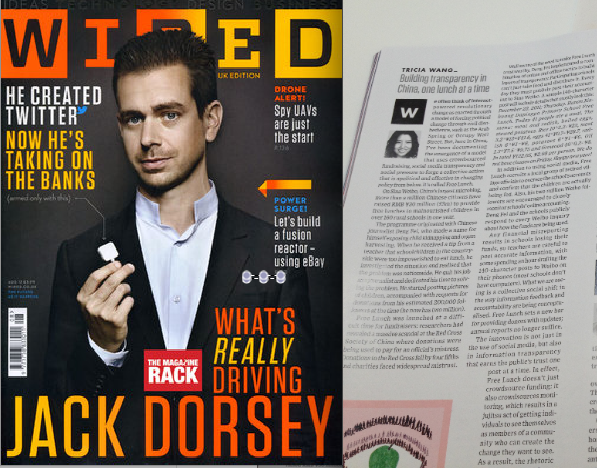
"Technology for Migrant Workers" Interview in Agenda Magazine

 I had a lovely time chatting with Abby McBride from Agenda Magazine.

Here's the article: Tracking Technology Among China's Non-Elite [pdf download].

I shared my thoughts on what Digital Urbanism 2.0 will look like when 3G smartphone use will be more pervasive and affordable. We also talked about the kinds of inequalities migrants face, what kind of dreams they have, and how they make do tough situations.

By the end of the interview, I admitted that the Chinese internet is absolutely overwhelming. There are so many new products, ideas, and practices emerging everyday that it's impossible to keep up. Luckily I have a great team of research assistants. If you're curious about what my research assistants are reading, check out our open tumblr blog. And for the latest info from my fieldwork, my reseach blog is Bytes of China.

The best part about chatting with Agenda Magazine was receiving the actual magazine and learning about all the other people who were interviewed and doing amazing work and creating really cool stuff.

What struck me in all of these interviews were each of their undestanding of the "social."

*Thanks Jennifer Thome and Abby McBride! :)

Thursday
Jun302011

The Atlantic covers my research on Weibo Instant Photo Phenomenon

Alexis Madrigal, senior editor of The Atlantic, wrote about how Weibo users are using it as a dating site based off of my research on Weibos' Instant Photo Singles Rescue Phenomenon

Madrigal makes a great point about this phenomenon:

...one excellent thing about the development of the Chinese Internet is that Americans get to look across the Pacific at something technically like our own tubes, but distinct along many vectors. Let it serve as a reminder that these systems are both contingent (i.e. stuff just happens) and influenced by the culture in which they're implanted.

I am in love with Madrigal's writing. I have a few favorite writers (e.g. Paul Ford, Anil Dash, James Gleick, Adam Gopnik, Tom Standage) who blend technology, everyday life, and big social issues into a warm blanket, and Madrigal is one of them. I just bought his newly released book Powering the Dream: The History and Promise of Green Technology. I can't wait to dig into it. Another one of my favorite oldie Madrigal piece is his sensitive and insightful reply to Zadi Smith's claim that facebook was making us less social, Literary Writers and Social Media: A Response to Zadie Smith. I subscribe to his RSS feed and put in folder, "FAVE WRITERS."

Thursday
May262011

An Xiao Mina's Article About my Research on Chinese Migrants living in Internet Cafes (Huffington Post)

Design strategist, new media artist, and digital community builder Anxiao Mina interviewed me for her latest article in Huffington Post on internet cafes in China, The 21st Century Saloon: A Peek Inside China's Wangba, or Internet Cafes. I really like the way Anxiao narrates our interview - she captured the essence of our trans-Atlantic conversation! (I have written more details about this talk in my post-SXSW notes here.) Here is the interview below, or you can read it on Huffungton Post. Thanks Anxiao!

It's 5 in the morning on a Monday, and California native Tricia Wang is waking up in a second-tier city in central China. An ethnographer and researcher in how disadvantaged groups like migrant and low-income communities use technology, she immerses herself in her research environment.

Today's office is a smoky wangba (网吧: Internet cafe), where she was lucky enough to snag a couch to crash on. Many of the patrons around her are sleeping upright, or sideways, at their desks. All around her are computers, computers, computers, and hundreds of individuals, almost all of them migrants from different parts of rural China.

Click to read more ...

Tuesday
May242011

My new blog about my research in China: Bytes of China! 

I’ve just moved to China to fieldwork on how non-elite users, youth, and migrants are using cellphones and the internet. I’ve decided to keep a separate blog of all my ethnographic observations so that it doesn’t get mixed in with my general observations about culture and technology on Cultural Bytes.

I will still blog on Cultural Bytes, but just not as often as most of my brain for the next year will be focused on just China. If I have Bytes of China posts that are specifically about culture and technology, I will repost them to Cultural Bytes.

See you on Bytes of China! Here is the RSS feed.

More about Bytes of China and the themes that I will be writing about.

Friday
Mar252011

Fun interview about Chinese migrants and internet cafes with Benjamen Walker's radio show, Too Much Information

I love the way my interview turned out on Benjamen Walker's Too Much Information. We met in Austin, Texas at SXSW and he ended up super fun to work with.

Benjamen has traveled to China several times and the converstaions we had was so refreshing. He didn't ask the same old questions that reporters usually go with.

We had a lovely conversation about the topics I had brought up in my SXSW presentation on Chinese migrants. Here's the episode below, Too Much Internet.  My interview is the last one starting at 38:45 (easier to select time code with the soundcloud file).

And check out the amazing line up of people he has on his show from Paul Ford to Analee Newitz!

Click to read more ...

Monday
Mar212011

Slides/Notes for my SXSW talk on my research in China & some reflections about SXSW 

Had great feedback from my sxsw panel #300MM! It's over!

En route to China, I stopped in Austin to give a talk at my first time at SXSW Interactive. What did I overhear the most at SXSW? 

Web 3.0 is here!  The reign of the virtual! Networked Sensors take over the world! This is all so new! Singularity man! Social media for good! The age of social media has dawned! Get online or perish! Gaming for good! Game to change the world!

These statements reflect the general level of techno-utopianism that I find at conferences on anything related to the internet. There usually is little room for critical analysis or social historicizing.

As Roy Christopher points out, we live in an age of information abundance but at times it seems like our abilities to historically contextualize current events is scarce. He's right and this particulary true for the SXSW audience who is so focused on the "new" that the "old" seems irrelevant. I have lots of qualms with technological uptopianism, but I think what's make it worse is historical amnesia. Many of the talks seem to think that the technology itself - or this year the focus was on social media or games themselves will solve our reality and make us "better."  An example of this is Simon Mainwaring's We First: How Social Media can Remake Capitalism and Build a Better World and Jane McDonigal's Reality is Broken: Why Games Make Us Better.  The ideas promoted in these books aren't necessarily wrong, but I find the analysis in these books resting more on future talk than on grounded research.

So for my first SXSW, I decided to give a talk that would not only illustrate my analysis and research on internet users in China, but also provide historical context for what we're seeing in China.  I explored the idea of telling a story that would be an old one - a story that would historicize the internet so that we could see how human emotions can create powerful reactions that repeat itself in differnet mediums, processes, and outcomes. I did this by paralleling the contemporary panic around rural-urban migrants in Chinese internet cafes to the 20th century panic around Italian and Irish immigrant in American saloons.  

Click to read more ...

Monday
Mar212011

Moving to China to do research! Will be blogging my year on BytesofChina.com!

moving to china! I'm happy and sad...Good day world! it’s finally happening! I’m moving to China to do my research! wooohoo!

So I’m moving to China to do my research, and then coming back to write something that I hope to buddha doesn’t kill my soul to write creative non-fiction. (here’s some more details about my research). I have a post on my personal blog about all the things and people that I will miss so dearly.

So in addition to doing my research, I’ll be posting daily observations on Bytes of China. I’m making a committment to post a little thought every other day. One, this let’s friends know that I’m alive, and second when I’m writing up my fieldnotes every month I would love to see over time what observations I chose to make public. While I plan to keep 99% of notes just for my eyes, there’s something very lovely about posting a short blog post that will be immediately read. It keeps me connected to the real world - otherwise I would get lost in my thoughts and forget that I have a responsbility to carry out when I return from the field - a responsibilty to translate what I see into greater understanding.

New RSS Feeds!

And for people who use RSS readers - I’ve combined all my blogs into ONE feed (using yahoo pipes). I created one feed just for research blogs and another feed for all blogs. You can find all the rss feeds at the bottom of my website.

Click to read more ...

Thursday
Feb172011

Speaking about the next 300 million Chinese internet users at SXSW in Austin, Texas on Future 15 Panel

(reposted from CulturalByt.es)

Just bought my tickets to Austin, Texas for SXSW - who else will be there? This will be my first SXSW! I get to play with the amazingly smart and playful Glenda Bautista, who invited me to join the Futures 15 line up.  Future 15’s are a SXSW curated panel of short talks on specific topics. Last year Baratunde was on the same panel and I heard that he killed it with his talk: How to be Black. This year, Glenda is moderating the panel again and giving her own talk on how to actually put together a kick ass panel that is diverse. Not as easy as it sounds so she’ll be breaking it down!

I’ll be on the Diversity and Social Justice panel on Saturday, starting at 3:30pm. My talk will be about the future of the internets from the perspective of 300 million Chinese migrants and the possibilities for social change. 

Sleeping at Internet Cafes: The Next 300 Million Chinese Users #300MM

Saturday, March 12th, 4pm

In China, over 300 million migrants reside in cities; these communities represent some of the most marginalized and poorest groups that are now actively incorporating new communication tools into their lives. These migrants are also the fastest adopters of digital tools and the quickest growing population of digital users. What do these coinciding cultural-technical processes mean for the people undergoing these shifts? Based on my fieldwork in China over the past three years, I focus on three areas that I think will point to the future of social change and innovation in China: gaming, entertainment, and consumption.

Click to read more ...

Wednesday
Dec012010

Spoke at “Creating Community Environments” at ITP, NYU

(resposted from CulturalByte.es)

I was a guest speaker at the wonderful Kristen Taylor’s seminar, Creating Community Environments, at New York University’s ITP program

I talked about my upcoming move to China to conduct one year of fieldwork. Here’s a short in-progress description of my research project and a link to my presentation. 

I also elaborated on the importance of understanding social ties as culturally embedded. Kristen had aleady assigned a piece that I wrote a few months ago as class reading, Privacy and The Anonymous user in China: Importance of understanding multiple cultural orientations towards guanxi/social connections. So we had a short discussion on why the meaning of a social ties are different China. 

I really enjoyed talking to a class of students from such diverse backgrounds. As I was leaving, Kristen started a discussion on potatoes as objects with agency based on their class assignment of Michael Pollan’s The Botany of Desire. Yes, that is how cool this class is - you too should consider going through a life transition, move to NYC,  and enroll at ITP just to take Kristen’s next course in the Fall of 2011. And companies - pay attention to these students if you want to hire people who really understand communities from a holistic point of view.

Kristen Taylor's course at NYU's ITP


Click to read more ...

Tuesday
Nov302010

My interview about ethnography and community relevance with Market Sentinel’s Dhiren Shingadia

(re-posted from CulturalByt.es)

Somehow the internets connected Dhiren Shingadia and I, which then evolved into a skype convo and then his interview with me: Understanding communities through ethnography (I recommend reading it here on Future Lab - better formatting).

Here are some of the questions that Dhiren asked me

  • As a sociologist and ethnographer, what are the core outputs of your studies at the moment?
  • What are the types of questions that you are asked the most?
  • Corporations, advertising agencies and communications consultancies are all moving to deliver cultural relevance or a degree of value to real-world communities. What are your thoughts on this?
  • From your perspective, are these actions translating into a greater a demand for research and ethnographic skills?
  • Your work requires you to observe people and investigate what motivates their actions and behaviour. Is the “power of the peer” as strong outside of west as it is in?
  • And finally…your work takes you across the globe, from one place to place another, and this allows you to become familiar with societies from all walks of life. Outside of the US, which country or region has some of the most interesting digital practices? Do any activities surprise you?
  • What can we learn from this country?
  •  

    So Dhiren and I chatted about our interests, the future of the internets, innovation, social media, Baidu, China, building communities, and cultural relevance. I explained to him the strategy I’ve been using since I started community organizing 8 years ago in NYC, which is that I focus on achieving community relevance, not cultural relevance.

    Oh and yes we also addressed the gazillion dollar question - what will happen when China rules the world? 

    Dhiren also has an amazing blog full of intellectual and silly goodies - I knew the moment that I went on his blog, Uba Contraversie, that I would love his energy! and I turned out to be right! Here’s Dhiren’s twitter, another twitter-trove of goodies. 

    oh and through Dhiren I found his colleague, Eli Gothill’s post on the rise of financial activism - definitely something to keep an eye on for the future.

    Friday
    Oct012010

    Gave a talk on ethnographic work and my own research at IT Univeristy in Copenhagen, Denmark

    Professor Irina Shklovski invited me to give a talk to her seminar at IT University in Copenhagen, Denmark. I spoke about my research question has evolved over the years and tips on doing ethnographic research. The slides below are from the portion of my talk about ethnography. 

    It was really cool to learn about the Danish education system. I found out that the government pays students  to get their masters! And professors cannot require that students attend classes, there is a strict word limit on how many reading a professor can assign, and students can delay their final exams or projects. 

    Thanks Irina for inviting me! 

    View more presentations from triciawang
    Wednesday
    Sep012010

    Presenting a paper that Morgan Ames and I wrote at Ubicomp 2010 in Copenhagen, Denmark

    I'll be presenting a paper at Ubicomp 2010 that I co-wrote with Morgan Ames. We conceived of our paper, Global Discourses of Information: Questioning the Free Information Regime, when we were talking the common themes that we were both seeing in our fieldwork.

    When we found out that our great friend (and my China researcher sidekick), Silvia Lindtner, was putting on a workshop (along with Irina Shklovski, Janet Vertesi, Paul Dourish) about the issues specific to technology design and research for transnational users or use contexts, we thought that would be a good place to begin thinking through some of our ideas that we had first discussed. Another cool thing that came out of this writing process was the launch of a new research blog that Morgan and I will be updating together, Info Peripeteia.

    Here's the abstract from our paper (download paper here):

    In three transnational case studies of ICT use, we unpack common social constructions of free information in the West: the market commoditization of information, the socially viral nature of information, the ethical role of information, and the physical (dis)embodiment of information. We connect these constructions under the ideology of “neo-informationalism” and explore sites of tension that this paradigm creates in global technosocial contexts. Finally, we discuss implications of this stance for ubiquitous computing and call for a reorientation on the contextualized, local, and sometimes messy present instead of an idealized global future.


    Saturday
    Jul312010

    I'm a Transatlantic Fellow with the British Council

    The British Counil has given me a TN2020 Transatlantic Fellowship!

    TN2020 builds innovative collaborations between young North Americans and Europeans to address challenges that will define their generation.  Designed to run until 2020, we are creating an expanding network of emerging leaders (25-35 yrs.) from the fields of business, arts, academia, civil society, media, science and politics, and encouraging and empowering them to develop solutions to global issues. These young people from Europe and North America are working to revitalise links and build new connections for the future.   The network currently features 150 members from 24 different countries across the two regions: united by their creativity, leadership and global awareness, they will make TN2020 their own.

    I'm super excited to spend a week in Chicago and meet all the other fellows. These kind of events are always fun because you get to meet tons of awesome new friends!

    Thanks Zadi Diaz for the recommendation!

    _____________

    UPDATE July 31, 2010: I had a great time in Chicago! I was part of Track 5: The Role of Innovation in the Public and Private Sector, faciliated by the Chicagoland Chamber of Commerce. Here are notes from my track and pictures from the summit.

    Tuesday
    Jun012010

    OMG I have been awarded a Fulbright! Off to China for 1 year of fieldwork!

    (re-posted from Cultural Bytes) I just found out that I have received a Fulbright to China!

    My proposal, Chinese Migrants Families in the Information Age: Intensive Technology and Digital Urbanism, has been approved for funding by the Chinese and US government for research!

    The Fulbright require that researchers remain in the host country for at least 10 months. So I’ll be moving to  Wuhan, China next March to conduct fieldwork for 1 year. These long-term research grants are truly the research ethnographer’s dream; it’s a luxury to do really in-depth fieldwork and to be funded to do it.  Surveys and brief visits can give you insight into daily life, but relying soley on those methods does not get at the depth of everyday life and the processes that people are dealing with. 

    So I’ll be looking at the socio-digital space for new ICT users in Wuhan. I want to find out how migrant families are appropriating new ICTs and how their ICT practices reflects the ways in which they are settling in to the city and making sense of the socio-economic changes in their lives. While most research on migrants have focused mostly on single or coupled migrants who intended to eventually return to their village, I see  a new wave of human mobility within China that points to migrants who move to the city as a family and who intend to stay in the city as a family. This new wave of migration is taking place in 2nd and 3rd tier cities (like Wuhan) that aren’t just economically open to migrants, but also socially and politically. I believe these understudied 2nd and 3rd tier cities are important sites of observation because not only are these cities projected to contain 75% of the growth in wealthiest families, they are also going to be sites of social transformations in China. 

    I’ll write another more about my research in another post. I have some stuff up online on the research section of my website, but I’ve already started reformulating my research questions as I’ve learned so much more about what kinds of research is more valuable to industries and those outside of academia after these few months of researching at Nokia. I'll be updating my dissertation info here and check out my blog just for updates while I'm in China, Bytes of China.

    Click to read more ...

    Monday
    Mar012010

    Working with Nokia Research and the IDEA team!

    (reposted from CulturalByt.es)

    I am so excited to announce that I’ve started a research internship with Nokia Research Center (NRC) Palo Alto!. I’m working with Jofish Kaye and the IDEA Team (Innovate Design Experience Animate), which is led by Mirjana Spasojevic. The IDEA team is super diverse and there are so many people doing cool things. 

    This is my first time working outside of academia and with a technology company as a  sociologist, so everything is new to me. I’m a baby to the CSCW, CHI, & HCI world. That’s why I’m really grateful to be working with Jofish, because I consider him to be really inter-disciplinary.

    How many people can claim that their mentor writes about almost everything in the world - from smells to epistemology? (at least that’s what it looks like from his publications)

     I’ve only been here for a few weeks but already I’m learning so much about the role of research in IT companies and how ethnographers can contribute to technology research. 

    I am working on two different projects and it’s starting to look like instead of only chossing one of them, they’ve each taken on a life of its own! The first one is about hacking/DIY/OSS, tinkering, and customization cultures. And the second project is about the social life of phones. We’re looking at things like gifting, sharing, and death of cellphones. If anyone has any research to share in any of these areas please share. I’m still in the exploratory phase so I would love to read your research!

    While I’m here - I am going to figure out how to take advantage of Nokia’s Simple Context app for my research. After talking with David Racz and Brett Clippingdale - the brains behind this app - I’m super excited to get it working on my N95 and N97. 

    My second goal is to work on publishing papers with Jofish. Up until now I’ve been stuck in course work and writing grants. Now that I’ve been awarded enough funding to move to CHina for my dissertation work I need to give some time to publishing papers. It’s interesting to work with CSCW researchers who crank papers out like every few months where in sociology it can take years to publish one paper. 

    And I get to hang out with Nokia researcher Liz Bales from UCSD and UI consultant, Janet Go who is working on Nokia’s Storyplay

    I am just bursting with happiness over all the people I’ve met and the amazing things that they are doing. In exploring our hacking topic, we’ve already met up with Daniela Rosner,  Elizabeth Goodman,  and Cristen Torrey. We also spoke to Jenna Burrell over at Berkeley. I love Jenna’s work. Just yesterday we had a long time with Jurgen Scheiblel and Ville Tuulos about Python programming and open source culture. I also spoke to Jurgen about his Mobi Spray project. Oh and I finally got to meet Morgan Ames - who’s now going to be my Spanish partner! I can’t believe all the people I’ve been reading throughout these years are all located here in one place…and they are real humans…and they are cool!

    Thanks Barry Brown. You’re such a great advisor for telling me that sociologists do get jobs outside of academia and that I can make meaningful contributions to the tech world! Thanks for introducing me to Jofish and setting up our talk at Nokia.

    Tuesday
    Jul012008

    Joined the US delegation to the China-India-US Workshop on Science, Technology and Innovation Policy Workshop

    policy experts on chinese, india and us technology policy  - yes the professional side of me

    I was so excited to be a member of the United States delegation to the China-India-US Workshop on Science, Technology and Innovation Policy Workshop. This NSF-funded program is part of George Mason University’s Science and Trade Policy Program and the conference this year was held at the National Institute of Advanced Studies (NIAS) in Bangalore, India. I sat on the Information Technology panel and learned a lot about the other two topics, coal and pharmaceuticals!

     We visited Biocon and InfoSys. I also met several nuclear policy and technology experts who taught me a lot about Indo-US nuclear policy. I have to admit that I was much more into the human interaction than sitting through each presentation. But what I learned in the hallways from the other delegates was worth all the time spent in panels. Here's a video below from the first day:


    Here are some photos and  details about the workshop:

    Much has been written about India and China as ‘emerging’ or, better,‘re-emerging’ powers on the world scene, and it is often stated that science and technology are essential keys to their re-emergence. The United States provides a model of a successful national innovation system which both countries have studied and selectively emulated. The China-India-US Workshop on Science, Technology and Innovation Policy was organized at the campus of the National Institute of Advanced Studies in Bangalore, from 7-9 July 2008, as a first step towards structuring an inquiry and, hopefully, catalyzing subsequent in-depth workshops and bi- or tri-national research partnerships. The event was supported by IUSSTF with additional support from the Chinese Academy of Sciences (CAS). 6 Chinese, 24 Indians, and 15 Americans participated in the workshop.

    The workshop consisted of three sessions, each devoted to a particular science and technology sector with the objective of illuminating the broad theme of the workshop by means of specific case studies on Power Generation by Coal, Information Technology, and Pharmaceuticals. During each of these sessions, a Chinese, an Indian, and a U.S. participant gave short, summary presentations on these topics. The presenters in the session on power generation from coal have begun a discussion on the possibility of a subsequent, in-depth workshop in 2009-10 which would have the objective of initiating specific collaborative trilateral research projects on clean coal technologies.

    Friday
    Feb012008

    Working with What Kids Can Do on their Beijing Youth Voices Project!

    Oh I'm so excited that I'll be starting this project with Barbara Cervone from U.S. based-nonprofit What Kids Can Do, Inc. and Adobe Youth Voices.

    We're going to offer six college scholarships to Bejing high school students for a six month after-school blogging program. This is a particularly exciting time since this is the year of the Olympics. Students will learn how to write about how they feel about the changes in Beijing as the country prepares for the world to arrive in China this summer. More details here about the project.

    Thanks Sharese Bullock for putting us in touch!